


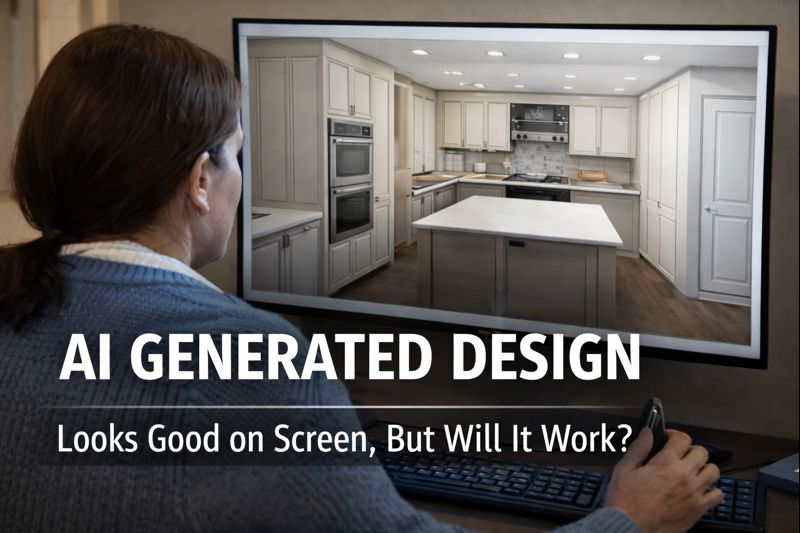
Artificial intelligence is everywhere right now. From generating images to answering questions instantly, AI tools can feel like a shortcut for just about anything, including kitchen design. Many homeowners are experimenting with AI to visualize layouts, try styles, or “design” their dream kitchen in minutes.
While AI can be a useful starting point, it falls short when it comes to planning a kitchen layout that actually works in real life. Here’s why AI alone isn’t the best tool for redesigning one of the most complex rooms in your home.
1. Kitchens Are About Function First, Not Just Looks
A kitchen layout isn’t just about where cabinets and appliances look good on a screen. It’s about how the space functions every day.
AI tools can generate visually appealing layouts, but they often miss critical functional considerations like:
- Proper work triangle flow
- Clearance for appliance doors and drawers
- Walkway spacing for multiple users
- Realistic storage needs
A layout that looks perfect in an AI rendering may feel cramped, awkward, or inefficient once it’s built.
2. AI Doesn’t Understand How You Actually Use Your Kitchen
Your lifestyle matters more than trends or templates. A kitchen for a family of five functions very differently than a kitchen for someone who rarely cooks or entertains frequently.
AI can’t fully account for:
- How often you cook and what you cook
- Whether multiple people use the kitchen at once
- Storage habits, small appliances, and pantry needs
- Accessibility or aging-in-place considerations
Human designers ask questions, listen, and adapt layouts based on real-world behavior. AI relies on assumptions.

3. Every Space Has Real-World Constraints AI Can’t See
AI doesn’t truly understand what’s behind your walls or under your floors.
It often overlooks:
- Structural limitations
- Plumbing and electrical realities
- HVAC placement
- Ceiling height variations
- Load-bearing walls
Ignoring these factors can lead to layouts that are either extremely costly or completely impossible to build without major structural changes.

4. Building Codes and Best Practices Matter
Kitchen layouts must comply with local building codes, safety standards, and manufacturer installation requirements.
AI tools are not reliable at accounting for:
- Code-required clearances
- Ventilation requirements
- Electrical outlet placement rules
- Appliance specifications
Professional designers and builders ensure layouts are not only beautiful, but safe, compliant, and build-ready.
5. AI Can’t Balance Budget and Value
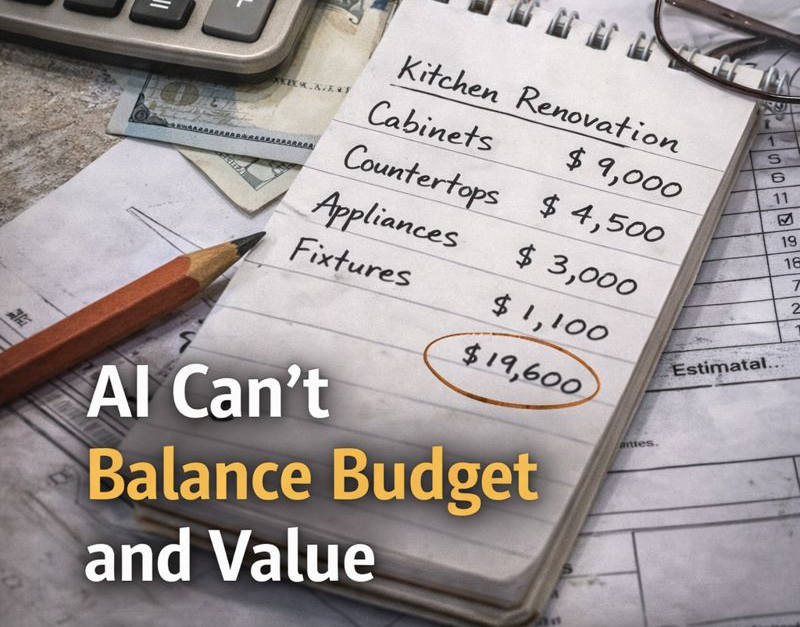
A great kitchen layout balances design ambition with budget reality.
AI may suggest:
- Excessive cabinetry
- Oversized islands
- Premium appliances without context
- Unrealistic material combinations
A professional helps prioritize where to invest and where to simplify, ensuring your layout delivers the most value for your budget.
6. Kitchens Require Nuance, Not Templates
AI tools often rely on patterns and popular layouts. While this can be helpful for inspiration, it can lead to cookie-cutter designs that don’t fully maximize your space.
Experienced designers notice nuances like:
- Awkward corners
- Sightlines from adjacent rooms
- Natural light placement
- How the kitchen connects to living areas
These details are hard to quantify, but they make a significant difference in how a kitchen feels.

Where AI Does Help
AI isn’t useless in kitchen design. It can be helpful for:
- Early inspiration
- Exploring styles and color palettes
- Visualizing rough concepts
- Helping homeowners articulate what they like and don’t like
The problem arises when AI is treated as a replacement for professional planning rather than a supplement.
The Bottom Line
A kitchen layout is too important and too complex to rely on AI alone. While technology can inspire ideas, it lacks the experience, judgment, and problem-solving skills needed to design a kitchen that truly works.
For a successful kitchen redesign, the best approach is a combination of inspiration tools and professional expertise. AI can spark ideas, but human designers and builders turn those ideas into functional, beautiful, and livable spaces.
Contact Form
We welcome your questions and comments. Please feel free to contact us by completing the following form.
